
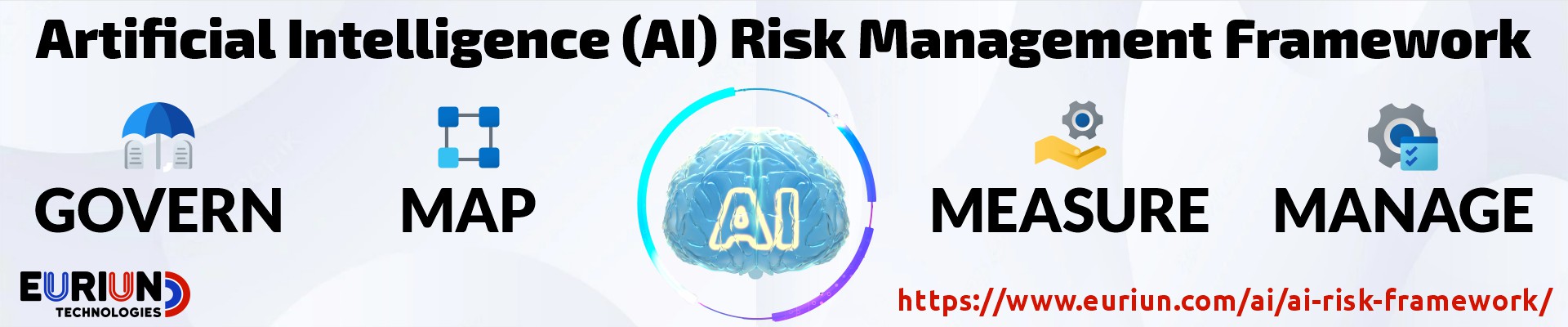
The Artificial Intelligence (AI) Risk Management Framework by NIST enables organizations designing, developing, deploying, or using AI systems to incorporate comprehensive AI Testing, Evaluation, Validation, and Verification (TEVV) practices, thereby managing the many risks of AI and promoting trustworthy and responsible development and use of AI systems.
The AI Risk Management Framework functions (GOVERN, MAP, MEASURE, MANAGE) can be applied to fit the interests and needs for organizations of all sizes and in all sectors.
GOVERN
The GOVERN function ensures policies, processes, procedures and practices across the organization related to the mapping, measuring and managing of AI risks are in place, transparent, and implemented effectively.
MAP
The MAP function establishes the context to frame risks related to an AI system. The AI lifecycle consists of many interdependent activities involving a diverse set of actors. The information gathered while carrying out the MAP function enables negative risk prevention and informs decisions for processes such as model management, as well as an initial decision about appropriateness or the need for an AI solution.
MEASURE
The MEASURE function employs quantitative, qualitative, or mixed-method tools, techniques, and methodologies to analyze, assess, benchmark, and monitor AI risk and related impacts.
MANAGE
The MANAGE function entails allocating risk resources to mapped and measured risks on a regular basis and as defined by the GOVERN function. Risk treatment comprises plans to respond to, recover from, and communicate about incidents or events.
| AID | 2 |
|---|---|
| Function | GOVERN |
| FID | GOV-1 |
| Description | Policies, processes, procedures, and practices across the organization related to the mapping, measuring, and managing of AI risks are in place, transparent, and implemented effectively. |
| Category | Governance and Oversight |
| GID | Govern 1.2 |
| Guidance | Policies, processes, and procedures are central components of effective AI risk management and fundamental to individual and organizational accountability. All stakeholders benefit from policies, processes, and procedures which require preventing harm by design and default. Organizational policies and procedures will vary based on available resources and risk profiles, but can help systematize AI actor roles and responsibilities throughout the AI lifecycle. Without such policies, risk management can be subjective across the organization, and exacerbate rather than minimize risks over time. Polices, or summaries thereof, are understandable to relevant AI actors. Policies reflect an understanding of the underlying metrics, measurements, and tests that are necessary to support policy and AI system design, development, deployment and use. Lack of clear information about responsibilities and chains of command will limit the effectiveness of risk management. |
| Recommendations | Organizational AI risk management policies should be designed to: - Define key terms and concepts related to AI systems and the scope of their purposes and intended uses. |
| Documentation | Organizations can document the following AI Transparency Resources GAO-21-519SP: AI Accountability Framework for Federal Agencies & Other Entities. [URL](https://www.gao.gov/products/gao-21-519sp) |
| Tasks | Trustworthy Characteristics, Governance, Validity and Reliability, Safety, Secure and Resilient, Accountability and Transparency, Explainability and Interpretability, Privacy, Fairness and Bias |
| Reference(s) | Off. Comptroller Currency, Comptroller’s Handbook: Model Risk Management (Aug. 2021). [URL](https://www.occ.gov/publications-and-resources/publications/comptrollers-handbook/files/model-risk-management/index-model-risk-management.html) GAO, “Artificial Intelligence: An Accountability Framework for Federal Agencies and Other Entities,” GAO@100 (GAO-21-519SP), June 2021. [URL](https://www.gao.gov/assets/gao-21-519sp.pdf) NIST, "U.S. Leadership in AI: A Plan for Federal Engagement in Developing Technical Standards and Related Tools". [URL](https://www.nist.gov/system/files/documents/2019/08/10/ai_standards_fedengagement_plan_9aug2019.pdf) Lipton, Zachary and McAuley, Julian and Chouldechova, Alexandra, Does mitigating ML’s impact disparity require treatment disparity? Advances in Neural Information Processing Systems, 2018. [URL](https://proceedings.neurips.cc/paper/2018/file/8e0384779e58ce2af40eb365b318cc32-Paper.pdf) Jessica Newman (2023) “A Taxonomy of Trustworthiness for Artificial Intelligence: Connecting Properties of Trustworthiness with Risk Management and the AI Lifecycle,” UC Berkeley Center for Long-Term Cybersecurity. [URL](https://cltc.berkeley.edu/wp-content/uploads/2023/01/Taxonomy_of_AI_Trustworthiness.pdf) Emily Hadley (2022). Prioritizing Policies for Furthering Responsible Artificial Intelligence in the United States. 2022 IEEE International Conference on Big Data (Big Data), 5029-5038. [URL](https://arxiv.org/abs/2212.00740) SAS Institute, “The SAS® Data Governance Framework: A Blueprint for Success”. [URL](https://www.sas.com/content/dam/SAS/en_us/doc/whitepaper1/sas-data-governance-framework-107325.pdf) ISO, “Information technology — Reference Model of Data Management, “ ISO/IEC TR 10032:200. [URL](https://www.iso.org/standard/38607.html) “Play 5: Create a formal policy,” Partnership on Employment & Accessible Technology (PEAT, peatworks.org). [URL](https://www.peatworks.org/ai-disability-inclusion-toolkit/the-equitable-ai-playbook/play-5-create-a-formal-equitable-ai-policy/) "National Institute of Standards and Technology. (2018). Framework for improving critical infrastructure cybersecurity. [URL](https://nvlpubs.nist.gov/nistpubs/cswp/nist.cswp.04162018.pdf) Kaitlin R. Boeckl and Naomi B. Lefkovitz. "NIST Privacy Framework: A Tool for Improving Privacy Through Enterprise Risk Management, Version 1.0." National Institute of Standards and Technology (NIST), January 16, 2020. [URL](https://www.nist.gov/publications/nist-privacy-framework-tool-improving-privacy-through-enterprise-risk-management.) “plainlanguage.gov – Home,” The U.S. Government. [URL](https://www.plainlanguage.gov/) |