
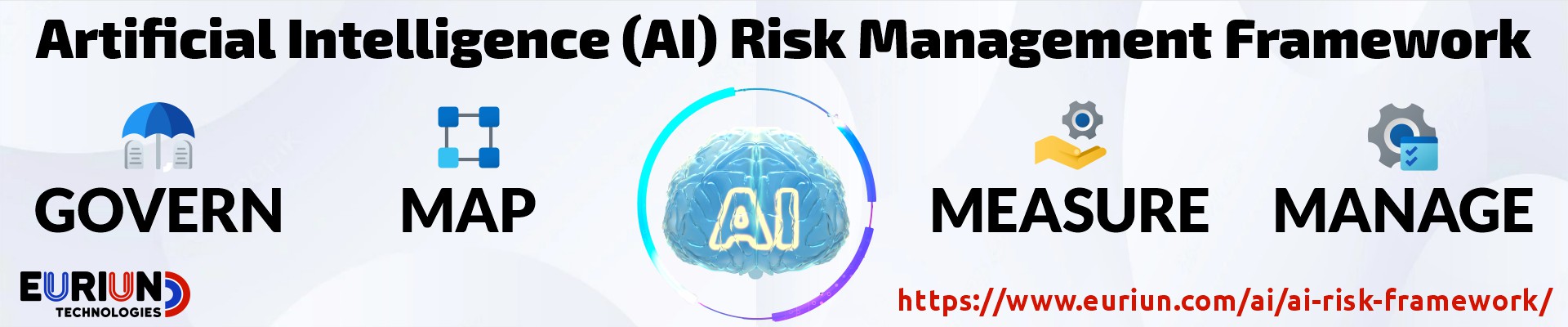
The Artificial Intelligence (AI) Risk Management Framework by NIST enables organizations designing, developing, deploying, or using AI systems to incorporate comprehensive AI Testing, Evaluation, Validation, and Verification (TEVV) practices, thereby managing the many risks of AI and promoting trustworthy and responsible development and use of AI systems.
The AI Risk Management Framework functions (GOVERN, MAP, MEASURE, MANAGE) can be applied to fit the interests and needs for organizations of all sizes and in all sectors.
GOVERN
The GOVERN function ensures policies, processes, procedures and practices across the organization related to the mapping, measuring and managing of AI risks are in place, transparent, and implemented effectively.
MAP
The MAP function establishes the context to frame risks related to an AI system. The AI lifecycle consists of many interdependent activities involving a diverse set of actors. The information gathered while carrying out the MAP function enables negative risk prevention and informs decisions for processes such as model management, as well as an initial decision about appropriateness or the need for an AI solution.
MEASURE
The MEASURE function employs quantitative, qualitative, or mixed-method tools, techniques, and methodologies to analyze, assess, benchmark, and monitor AI risk and related impacts.
MANAGE
The MANAGE function entails allocating risk resources to mapped and measured risks on a regular basis and as defined by the GOVERN function. Risk treatment comprises plans to respond to, recover from, and communicate about incidents or events.
| AID | 4 |
|---|---|
| Function | GOVERN |
| FID | GOV-1 |
| Description | Policies, processes, procedures, and practices across the organization related to the mapping, measuring, and managing of AI risks are in place, transparent, and implemented effectively. |
| Category | Governance and Oversight |
| GID | Govern 1.4 |
| Guidance | Clear policies and procedures relating to documentation and transparency facilitate and enhance efforts to communicate roles and responsibilities for the Map, Measure and Manage functions across the AI lifecycle. Standardized documentation can help organizations systematically integrate AI risk management processes and enhance accountability efforts. For example, by adding their contact information to a work product document, AI actors can improve communication, increase ownership of work products, and potentially enhance consideration of product quality. Documentation may generate downstream benefits related to improved system replicability and robustness. Proper documentation storage and access procedures allow for quick retrieval of critical information during a negative incident. Explainable machine learning efforts (models and explanatory methods) may bolster technical documentation practices by introducing additional information for review and interpretation by AI Actors. |
| Recommendations | - Establish and regularly review documentation policies that, among others, address information related to: |
| Documentation | Organizations can document the following AI Transparency Resources |
| Tasks | Risk Management, Governance, Documentation |
| Reference(s) | Bd. Governors Fed. Rsrv. Sys., Supervisory Guidance on Model Risk Management, SR Letter 11-7 (Apr. 4, 2011). Off. Comptroller Currency, Comptroller’s Handbook: Model Risk Management (Aug. 2021). [URL](https://www.occ.gov/publications-and-resources/publications/comptrollers-handbook/files/model-risk-management/index-model-risk-management.html) Margaret Mitchell et al., “Model Cards for Model Reporting.” Proceedings of 2019 FATML Conference. [URL](https://arxiv.org/pdf/1810.03993.pdf) Timnit Gebru et al., “Datasheets for Datasets,” Communications of the ACM 64, No. 12, 2021. [URL](https://arxiv.org/pdf/1803.09010.pdf) Emily M. Bender, Batya Friedman, Angelina McMillan-Major (2022). A Guide for Writing Data Statements for Natural Language Processing. University of Washington. Accessed July 14, 2022. [URL](https://techpolicylab.uw.edu/wp-content/uploads/2021/11/Data_Statements_Guide_V2.pdf) M. Arnold, R. K. E. Bellamy, M. Hind, et al. FactSheets: Increasing trust in AI services through supplier’s declarations of conformity. IBM Journal of Research and Development 63, 4/5 (July-September 2019), 6:1-6:13. [URL](https://techpolicylab.uw.edu/wp-content/uploads/2021/11/Data_Statements_Guide_V2.pdf) Navdeep Gill, Abhishek Mathur, Marcos V. Conde (2022). A Brief Overview of AI Governance for Responsible Machine Learning Systems. ArXiv, abs/2211.13130. [URL](https://arxiv.org/pdf/2211.13130.pdf) John Richards, David Piorkowski, Michael Hind, et al. A Human-Centered Methodology for Creating AI FactSheets. Bulletin of the IEEE Computer Society Technical Committee on Data Engineering. [URL](http://sites.computer.org/debull/A21dec/p47.pdf) Christoph Molnar, Interpretable Machine Learning, lulu.com. [URL](https://christophm.github.io/interpretable-ml-book/) David A. Broniatowski. 2021. Psychological Foundations of Explainability and Interpretability in Artificial Intelligence. National Institute of Standards and Technology (NIST) IR 8367. National Institute of Standards and Technology, Gaithersburg, MD. [URL](https://doi.org/10.6028/NIST.IR.8367) OECD (2022), “OECD Framework for the Classification of AI systems”, OECD Digital Economy Papers, No. 323, OECD Publishing, Paris. [URL](https://doi.org/10.1787/cb6d9eca-en) |